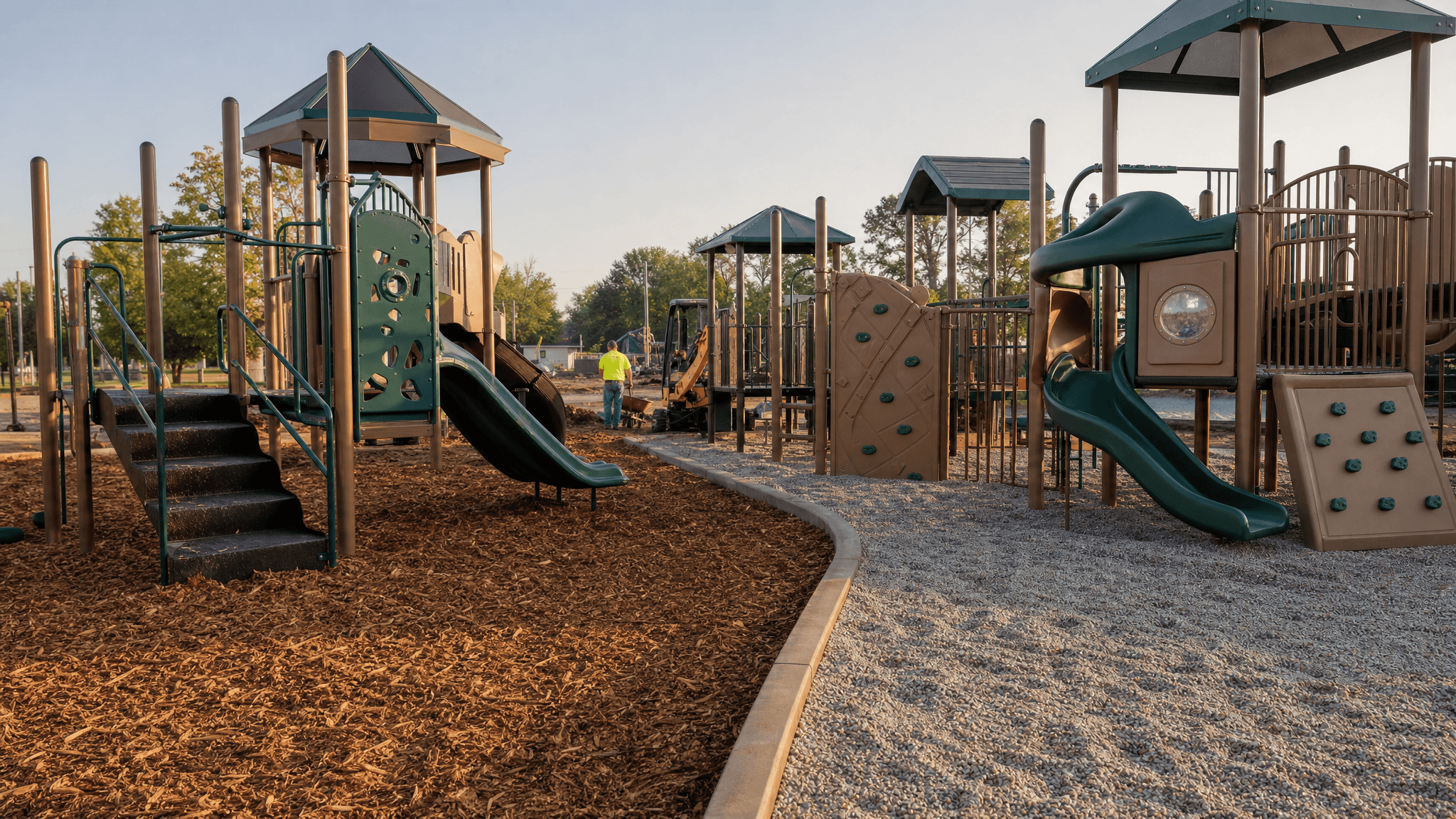
Architects love pea gravel. It photographs beautifully. It has that natural, earthy look that gets specified on municipal park designs and school renovation RFPs. Then you show up to install it and realize the problems start before you even open a bag.
If you've been handed a spec sheet calling for pea gravel on a playground surface, you need to know what you're walking into-and what your client doesn't realize they're asking for.
The Compliance Reality
This is where the comparison ends for most commercial playground projects: pea gravel is not ASTM F1292 compliant.
The CPSC Handbook for Public Playground Safety (Pub. No. 325) explicitly lists materials that are NOT recommended for playground use-and "gravel (pea gravel)" is on that list. ASTM F1292 requires impact attenuation testing to established critical height ratings. Loose gravel doesn't hold depth consistently, migrates freely, and cannot be certified to a specific fall height. If a child gets hurt on a pea gravel surface and the site owner can't produce ASTM compliance documentation, the liability exposure is significant.
Engineered Wood Fiber (EWF), by contrast, is ASTM F1292 tested and rated. IPEMA-certified EWF products are available from reputable suppliers and come with critical height documentation you can hand to the facility manager. That paper matters when insurance adjusters show up.
The ADA Problem No One Talks About Until It's Too Late
ASTM F1951 governs accessibility on playground surfaces-it measures whether a wheelchair can navigate the surface. EWF, when properly installed and maintained, meets ASTM F1951. Pea gravel does not, and cannot. Gravel shifts under load, creates ruts, and provides no firm stable surface for mobility devices.
This means: if you're building for a school, a municipal park, a federally-funded recreation facility, or anywhere covered by ADA Title II or Title III requirements-pea gravel is disqualifying. It's not a preference call. It's a compliance failure.
Builders who install pea gravel at ADA-covered sites are putting their clients in a position to receive a federal complaint and pay for a full surface replacement. That conversation with the owner is much harder after the job is done.
Installation: What Actually Happens on the Job Site
EWF installation:
- Containment borders required (timber, concrete, or steel edging)
- Install to critical-height depth: 6" for falls up to 7', 9" for falls up to 10', 12" for falls up to 12'
- Rake level after delivery and before opening to the public
- Expect 10-20% settling in the first season; plan for a top-off delivery
- Total material quantities: calculable. Installation timeline: predictable.
Pea gravel installation:
- Also requires containment borders-but gravel migrates far more aggressively than EWF
- Pea gravel compacts unevenly and gaps can form under high-impact zones
- Because it can't be certified to a critical height, there's no clear standard for "how deep is deep enough"
- Gravel throws. Kids kick it out of the play zone, onto sidewalks, parking lots, and into buildings on the soles of shoes
- Ongoing callbacks to redistribute material that's wandered outside containment
Bottom line on installation: EWF requires more upfront precision-depth stakes, moisture content awareness, level raking. Pea gravel feels easier to dump and spread. But the field reality is that gravel creates a recurring maintenance problem that EWF doesn't.
Maintenance: The Long Game
After the install crew leaves, the facility staff live with the surface choice. Here's how that plays out:
| | Engineered Wood Fiber | Pea Gravel | |---|---|---| | Annual top-off | Yes ( plan 10-20% replenishment | Yes ) plus redistribution from migration | | Raking frequency | Monthly or after heavy use | Weekly in high-traffic areas | | ADA compliance over time | Maintained with proper depth care | Cannot achieve | | ASTM compliance documentation | Available with certified EWF | Not achievable | | Debris tracking | Minimal | Gravel tracked into buildings and lots | | Injury risk | Low with maintained depth | Elevated, trip hazards, thrown gravel |
Facilities managers who've maintained both surfaces consistently report that pea gravel becomes a management headache within the first season. The material migrates, kids weaponize it, and there's no documentation standard to satisfy during safety inspections.
When Pea Gravel Gets Specified (And Why)
The most common reason pea gravel appears on a spec sheet: the architect or specifier isn't a playground industry specialist. They know it's used in drainage applications, it looks natural, and it's inexpensive at the supply house. They don't know about ASTM F1292, ASTM F1951, or the CPSC handbook.
Your job as the builder is to flag it before you sign the contract-not as a complaint, but as professional expertise. Say: "We need to confirm this surface meets ASTM F1292 requirements. Pea gravel isn't certifiable to a critical height and the site will have ADA accessibility issues. We can substitute EWF at a comparable cost and give you full compliance documentation."
Most clients, when they understand the liability exposure, make the right call. The ones who don't-make sure your scope of work documents that you raised the concern and they declined to change the spec.
The Bottom Line for Playground Builders
For virtually every commercial playground installation-school, municipal park, church, HOA, healthcare campus, or fitness complex-EWF is the correct material. It's ASTM F1292 compliant, ADA accessible, documentable, and predictable to install and maintain.
Pea gravel has a very narrow window of appropriate use: decorative landscaping or limited private residential applications where no safety surfacing standard applies. It doesn't belong under playground equipment where children can fall.
If you're sourcing EWF for your next project, GetMulch delivers certified engineered wood fiber nationwide-with delivery documentation, material specs, and depth verification records built into every order. Get a quote at getmulch.com.