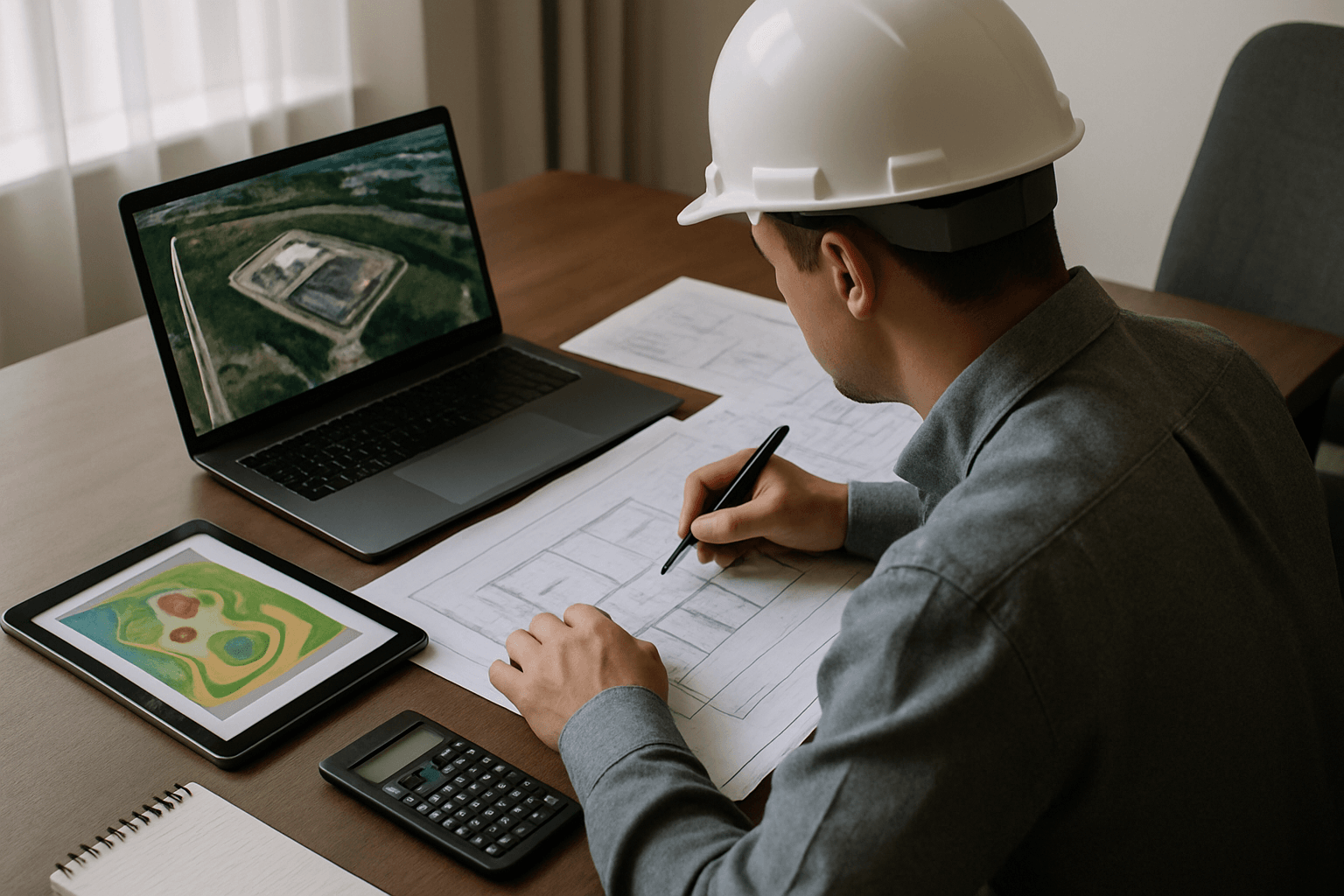
A client sends you plans, asks for a quote, and you've never set foot on the property. Maybe it's two states away. Maybe they need numbers fast and can't wait for a site visit. Either way, you need to price a job blind.
This is tricky territory. Quote too low and you're eating costs you didn't anticipate. Quote too high and someone else gets the job. Here's how to build a number you can stand behind without seeing the site in person.
Get the Plans, Not Just the Dimensions
When a client says "we need mulch for a 40x60 playground," that's not enough information. You need actual drawings, not just numbers on an email.
Ask for:
- Equipment layout showing fall zones and use zones
- Site survey or topographic plan showing grade changes
- Containment details (concrete curb, timber, flex edge)
- Access points marked on the plan
- Any existing surfacing that needs to be removed
If they don't have formal plans, ask for photos. Lots of photos. Photos of the existing surface, the access gate, the ground slope, adjacent landscaping, anything that might affect how you get material in and how you spread it.
Calculate Conservatively
Without a site visit, you can't verify what the plans show. That means building in a margin for the things you can't see.
Area calculations: Round up, not down. If the use zone calculates to 2,847 square feet, quote for 3,000.
Depth requirements: Use the higher end of the acceptable range. If spec allows 12-15 inches, calculate material for 14 inches. Settlement and displacement will eat into your number anyway.
Waste factor: Add 10-15% for a job you've never seen. You can reduce this to 5-8% on projects where you know the site. But remote quoting means remote surprises, and surprises usually cost you material.
Build in an Access Unknown
The single biggest variable you can't assess from plans is site access. A drawing shows you where the playground is. It doesn't show you:
- Whether the access gate is wide enough for your delivery truck
- Whether the path from the gate to the work area can handle equipment weight
- Whether there's a slope, a curb, or a drainage channel between the drop point and where the mulch goes
- How far your crew has to wheelbarrow material if the truck can't get close
When you can't see access, quote as if access is difficult. Add labor hours for hand-moving material. If the job turns out to have great access, you come in under budget. If access is bad, you're covered.
Ask Specific Questions
Don't assume anything. Send the client a list of questions before you price. Some examples:
- What's the maximum vehicle weight the access path can support?
- Is there an existing surface that needs removal, and who's responsible?
- What's the distance from the nearest truck-accessible point to the work area?
- Are there any underground utilities, irrigation, or drainage in the work zone?
- Will other trades be working on site during your installation window?
Good clients will answer these. If they can't or won't, that tells you something about the project too.
Build in a Site Visit Contingency
For any job over a certain dollar amount, consider adding a line item for a site visit before work begins. Quote the job based on plans, but include language that says final pricing is contingent on a pre-construction site walk.
This protects you from the 40x60 playground that turns out to be on a 15-degree slope with no truck access within 200 feet. You priced what they showed you. The actual site is different. The actual price is different too.
Some clients will push back on this. Stand firm. "We're happy to provide a planning estimate based on the drawings, but installation pricing requires a site verification."
Document Your Assumptions
Every remote quote should include a clear list of what you assumed to be true. Put it right in the proposal:
"This quote is based on the following assumptions:
- Equipment access within 50 feet of the work area
- Grade change of less than 6 inches across the installation zone
- No existing surfacing removal required
- Standard soil conditions (no rock, no standing water)
If site conditions differ from these assumptions, pricing will be adjusted accordingly."
This isn't about protecting yourself legally (though it helps). It's about making sure the client understands what they're getting for the number you gave them.
Use Google Earth and Street View
Before you put a number on paper, spend 5 minutes looking at the site remotely.
- Google Earth shows you the general layout, adjacent structures, and sometimes lets you measure distances.
- Street View (if available) shows you gate widths, curb heights, and parking lot conditions.
- County GIS sites often have parcel maps with topographic overlays.
None of this replaces a real site visit. But it catches obvious problems before you commit to a price. If Street View shows a narrow gate with bollards and a 90-degree turn, you know truck access is an issue even if the client didn't mention it.
Know Your Walk-Away Price
Some remote jobs aren't worth quoting. If the plans are incomplete, the client can't answer basic questions, and the project is far enough away that a pre-construction visit costs real money, you might be better off passing.
There's no rule that says you have to quote every job that comes across your desk. A bad remote quote that turns into a money-losing project isn't worth the win.
When you do quote sight-unseen, make sure your number works even if conditions are worse than expected. If the only way the job pencils out is if everything goes perfectly, you're gambling. Sometimes you win those gambles. Usually you don't.