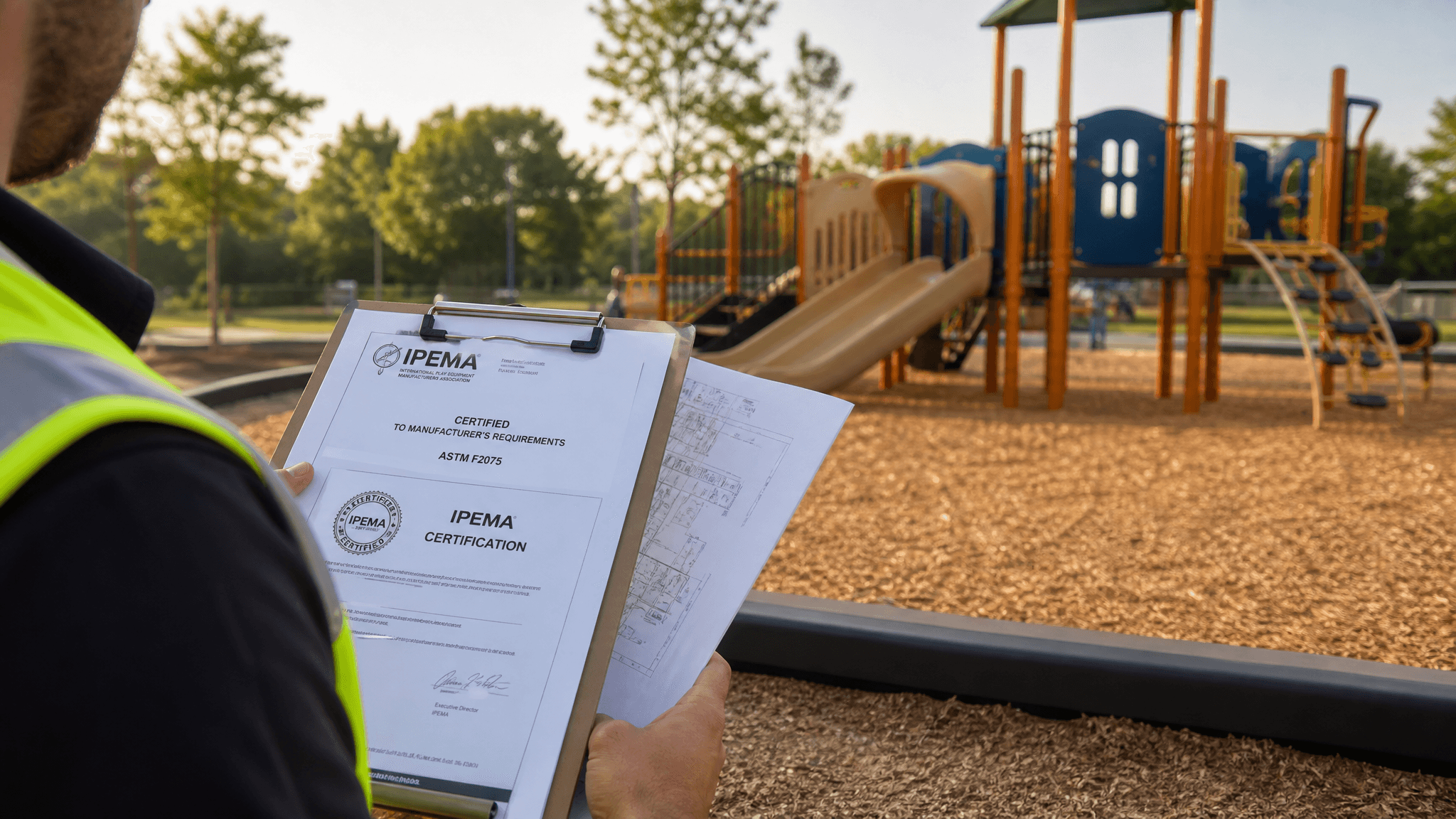
Why Certification Claims Aren't Enough
Any supplier can print "safety certified" on a bag of mulch. What playground builders actually need is documentation that proves a product was tested by an independent laboratory against the standards that govern playground safety surfaces, specifically ASTM F1292 (impact attenuation) and ASTM F2075 (engineered wood fiber specification).
That's exactly what IPEMA certification provides.
IPEMA ( the International Play Equipment Manufacturers Association ) runs a third-party certification program that takes product claims out of the manufacturer's hands. To carry IPEMA certification, a product has to be submitted to an accredited, independent test lab. The lab runs the actual safety tests. IPEMA reviews the results and issues the certificate. The manufacturer doesn't grade their own homework.
For playground builders and spec writers, this matters at every stage of a project: during procurement, during inspection, and especially when a liability question comes up after the fact.
What the Certification Actually Covers
IPEMA offers certification under three primary programs for playground surfacing:
ASTM F1292 Certification: Impact attenuation. This is the core safety test. The product is evaluated to confirm it can protect a child from a head injury in a fall from a specified height. The certificate will list the critical fall height the product is rated for at a given depth (typically 9", 12", and sometimes other depths). If a product doesn't have this certification, you have no independent confirmation it will actually perform when it counts.
ASTM F2075 Certification: Engineered wood fiber specification. This standard governs the physical properties of EWF as a material: particle size, moisture content, ash content, and debris limits. A product certified to F2075 has been tested to confirm it meets the material quality standard, not just impact performance.
ASTM F1951 Certification: Accessibility. This covers whether the surface provides accessible routes for wheeled mobility devices. Required on ADA-accessible routes within playground areas.
When you order mulch for a project, you should know which certifications the product holds and at what depths it has been tested.
How to Read a Certificate of Conformance
When a supplier provides a Certificate of Conformance (CoC), here is what to look for:
Product name and manufacturer: Should match exactly what you ordered. Generic names like "playground mulch" without a specific product designation are a warning sign.
Standard covered: The certificate should explicitly state "ASTM F1292," "ASTM F2075," or both. A vague reference to "safety standards" does not count.
Testing laboratory: Should be an accredited, independent lab. Common ones include SGS, Intertek, and Bureau Veritas. If the testing was done in-house by the manufacturer, it is not independent certification.
Critical fall height ratings by depth: The F1292 certificate should list specific fall heights at specific installed depths. Example: 9 inches installed depth rated for a 7-foot critical fall height. If the certificate only states a general rating without specifying depth, it is incomplete.
Certificate date and expiration: IPEMA certificates are not permanent. Products must be re-tested periodically. An expired certificate means the product has not been recently re-validated.
IPEMA participant ID: IPEMA-certified products will reference an IPEMA participant number. This is your path to independent verification.
How to Verify Certification Directly
Do not rely solely on a certificate the supplier hands you. IPEMA maintains a public participant database at ipema.org. Before you place a large order, spend two minutes checking:
- Go to ipema.org/certified-products
- Search by product name or manufacturer
- Confirm the product appears in the database with current certification status
- Match the IPEMA participant ID on the CoC to the listing in the database
If a product does not appear in the IPEMA database, it is not currently IPEMA-certified, regardless of what the CoC says. Certificates can lapse, be revoked, or simply be fabricated. The database is the authoritative source.
For school districts, municipal projects, and federal contracts, this verification step is often required by spec. Even on private projects, the five-minute check can save you significant exposure if a safety incident occurs.
Questions to Ask Suppliers Before You Order
Use these questions as your standard pre-order checklist:
"What IPEMA certifications does this product hold?": Should name F1292, F2075, and/or F1951. Vague answers indicate the supplier does not know or the product is not certified.
"Can you provide the current Certificate of Conformance?": The CoC should be current and not expired. If they have to dig for it or send a PDF from three years ago, that tells you something.
"What is the IPEMA participant ID?": This lets you cross-reference against the IPEMA database yourself.
"What critical fall heights is this product rated for at 9 inches and 12 inches installed depth?": A real certified product will have specific numbers for specific depths. If the answer is vague ("it is rated for playgrounds"), the product may not meet the standard at your required depth.
"Has this product been tested to ASTM F2075 for material quality?": Impact performance and material quality are separate certifications. Both matter.
Red Flags in Supplier Claims
Watch for these when evaluating suppliers:
- "Meets ASTM standards" without a third-party certificate. Self-declarations are not the same as certification. ASTM standards are testing methods; IPEMA certification means an accredited lab actually ran the tests.
- Expired certificates: Products need ongoing re-testing. An expired CoC means you are relying on outdated data.
- Missing lab name: If you cannot identify who performed the testing and verify they are an accredited lab, the documentation is incomplete.
- No IPEMA participant ID: Without this, you cannot verify the product in the IPEMA database.
- Mismatched product names: If the name on the CoC does not exactly match the product being delivered, you may have a spec compliance problem on your hands.
GetMulch: IPEMA-Certified Products Only
GetMulch carries IPEMA-certified engineered wood fiber and surfacing materials. Every product in our catalog comes with current documentation. ASTM F1292 impact attenuation ratings by depth, ASTM F2075 material certification, and IPEMA participant IDs you can verify directly.
When you place an order through GetMulch, you are not chasing down certificates or hoping the supplier can find the paperwork. Compliance documentation comes with every delivery.
Ready to order certified surfacing for your next project? Get a quote at GetMulch.com.