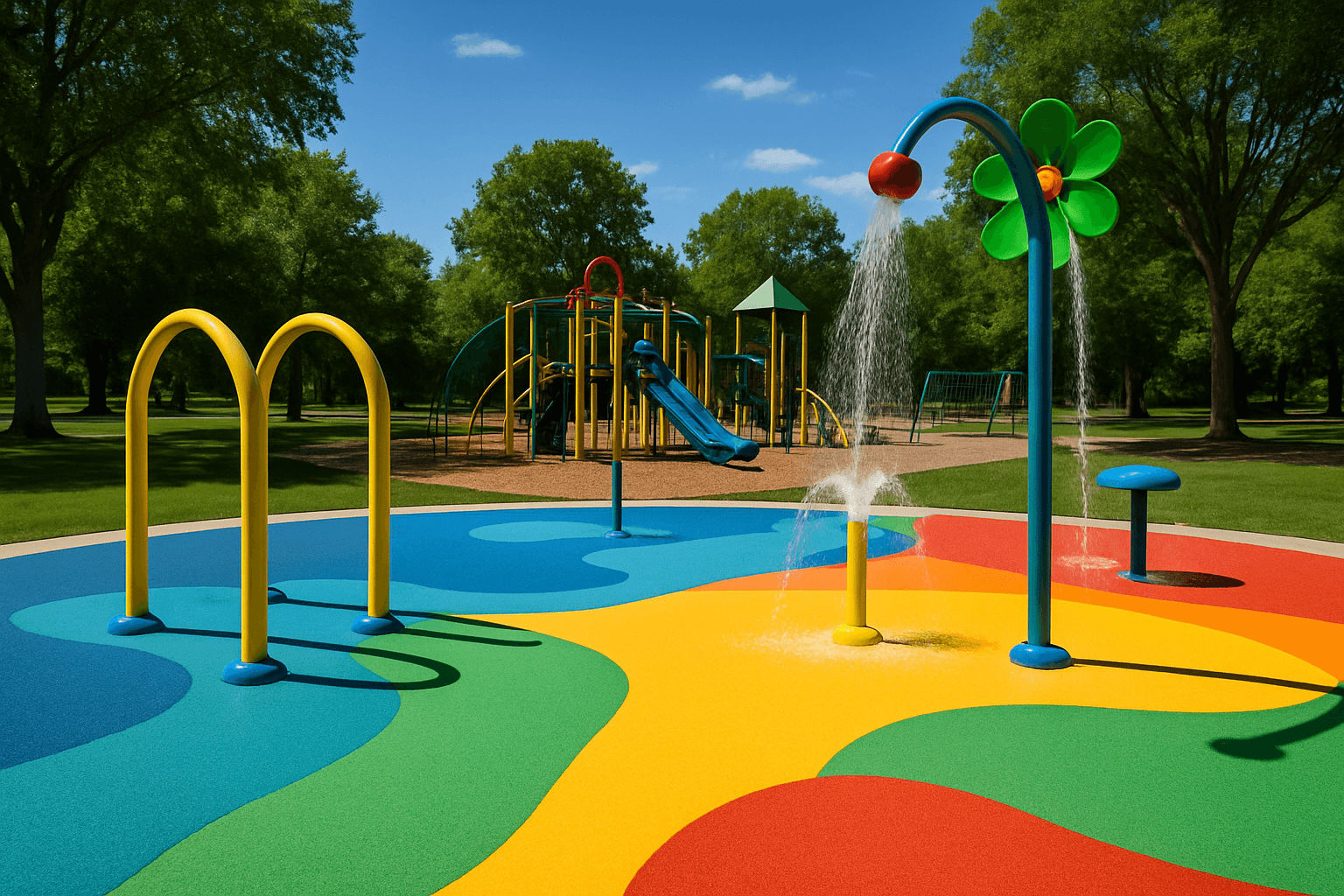
Splash pads are everywhere now. Parks, apartment complexes, community centers. They often sit next to dry play equipment. The surfacing needs are completely different in the wet zone versus the dry zone, and getting the transition wrong creates problems.
Why EWF Does Not Work in Wet Zones
Engineered wood fiber absorbs water. When it stays wet, it breaks down faster, compacts unevenly, and can harbor bacteria. A splash pad that runs water over EWF several hours a day will destroy that surfacing in one season.
Never install EWF in an area that will be regularly wet. This includes directly under spray features, in drainage channels, and anywhere water pools or flows.
If a client asks for mulch under their splash pad, explain the problem. EWF is for dry play areas. Wet zones need different materials.
Poured-in-Place and Rubber Tile Options
Wet zones typically use poured-in-place rubber (PIP) or interlocking rubber tiles. Both shed water, resist degradation, and provide the impact attenuation splash pads need.
Poured-in-place is seamless. No joints for water to penetrate. It can slope to drains without creating trip hazards. It is more expensive to install but lasts longer with proper maintenance.
Rubber tiles interlock and can be replaced individually if damaged. They work well for flat or nearly flat surfaces. Slopes require careful installation to prevent water from undermining tile edges.
Both options meet ASTM F1292 for impact attenuation. Both work in wet environments. The choice usually comes down to budget and site conditions.
Drainage Requirements
Splash pads generate a lot of water. That water needs somewhere to go. If drainage is inadequate, you get standing water, algae growth, and accelerated surfacing wear.
Design the surfacing to direct water toward drains. PIP can be sloped during installation. Tiles need an underlying substrate that slopes correctly.
Check with the splash pad installer about drainage requirements before quoting surfacing. They may have specific slopes, drain locations, or flow rates that affect your installation.
Transition Zones
The tricky part is where wet meets dry. A splash pad next to a swing set needs two different surfacing types with a clean transition between them.
Options for transitions:
Curb or border. A concrete curb or rubber border separates wet from dry. Water stays in the wet zone. Clean visual break. Adds cost but simplifies maintenance.
Gradient transition. Tile or PIP extends into the "sometimes wet" zone, then transitions to EWF in the always-dry area. Requires careful planning to avoid water migration into the EWF.
Complete separation. Wet and dry play areas have a gap between them, like a grass strip or sidewalk. Simplest solution if the site layout allows it.
Maintenance Differences
Wet surfacing requires different maintenance than dry.
PIP and tiles need regular cleaning to prevent algae and bacteria. Power washing works but check manufacturer recommendations for pressure limits. Some surfaces need periodic sealing.
Inspect drains regularly. Clogged drains cause standing water which causes everything else to fail faster.
Rubber surfaces in wet environments may develop surface wear faster than in dry applications. Budget for periodic top coating or replacement of worn sections.
Coordinating With Splash Pad Installers
The splash pad installer handles plumbing, pumps, and spray features. You handle surfacing. Coordinate carefully.
Who is responsible for drainage infrastructure? Usually the splash pad installer, but confirm in writing.
When can surfacing happen? Often after plumbing is roughed in but before spray features are final tested.
What slopes and elevations are required? Get this from the splash pad drawings before you quote.
Miscommunication here creates change orders. Get everything in writing during the bid process.
The Bottom Line
Splash pads need different surfacing than dry playgrounds. Use rubber products in wet zones, EWF in dry zones, and plan the transition carefully. Coordinate with the splash pad installer early and put drainage requirements in writing.