After the Storm, Before the Gates Open
Storms don't warn you before they mess up your playground surfaces. Wind moves mulch. Rain compacts it. Heavy limbs drop into fall zones. By the time the clouds clear, you've got a site that looks fine from the parking lot but fails a safety check at ground level.
That's the problem. Parents show up the next morning. Kids are on the equipment before you've had a chance to verify anything. If someone gets hurt on a surface that lost critical depth or got contaminated overnight, the liability lands on you and your client.
Here's the inspection checklist every playground builder needs to run after a storm. Keep it in your truck. Run it before the gates open.
Step 1: Visual Sweep Before You Touch Anything
Walk the full perimeter first. You're looking for anything that doesn't belong and anything that's moved.
Watch for:
- Tree limbs, branches, or large debris in the fall zone
- Displaced containment borders (especially timber or plastic edging that absorbed water)
- Mulch washed or blown outside the surfaced area
- Exposed concrete footings, anchor bolts, or base material where mulch shifted away
- Standing water pooling inside the fall zone
Don't start moving material yet. You want a clear read of what happened before you disturb it. Take photos of anything that looks wrong. Date stamps on job site photos are worth more than a written report when a claim comes in six months later.
Step 2: Probe the Critical Fall Zones
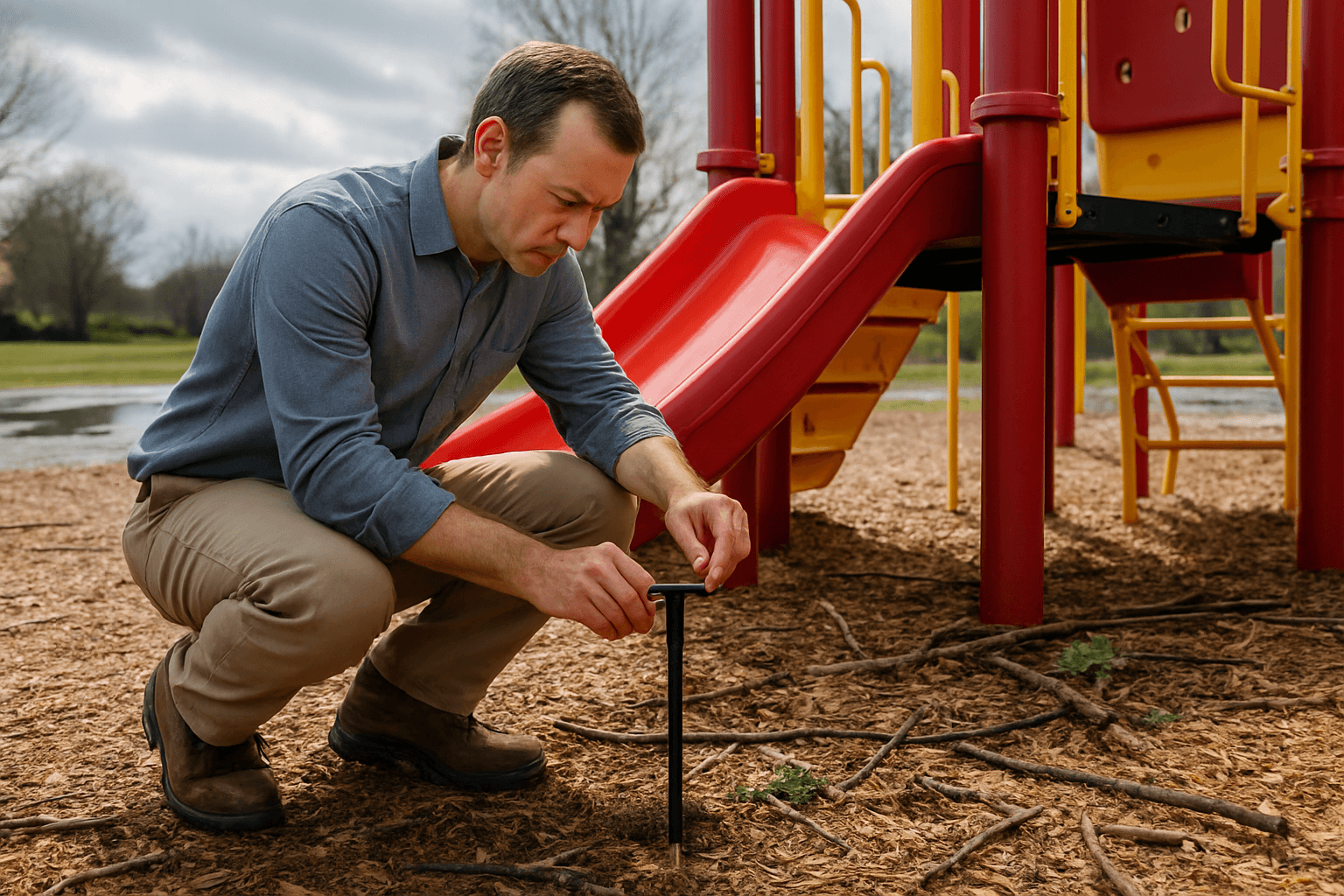
This is where the real inspection work happens. Storms compact EWF and rubber mulch differently. Heavy rain compresses engineered wood fiber fast. Wind displacement creates thin spots in unpredictable places.
ASTM F1292 sets the impact attenuation requirement. That compliance depends on depth, and depth changes after every major storm.
Use a rigid depth probe or a marked stake. Don't guess.
Check depth at:
- The base of every slide exit
- Each swing bay at the maximum arc point
- Every climbing structure under the highest equipment point
- The landing zones at bottom rungs and ladders
- Any area that looked visually low during your sweep
The standard minimum is 9 inches of loose EWF for most playground equipment heights. Rubber mulch holds up better under rain but can shift under wind. If you're at 8 inches or under in any critical zone, you're adding material before that playground reopens. Full stop.
Document every reading: zone, equipment, depth, date. If it's going into a report or an operations log, you want exact numbers, not a note that says it "looked okay."
Step 3: Check for Drainage Issues and Subsurface Saturation
Standing water in the fall zone is more than a nuisance. Saturated EWF loses its impact attenuation. Water also accelerates decomposition and mold growth beneath the surface.
Push the probe down and pull back a handful of material from about 3 to 4 inches depth. If it's wet and clumped, the subsurface is saturated.
What you're looking for:
- Areas where water has no path out (blocked drainage, low spots in the subgrade)
- Compacted surface crust holding water instead of draining
- Discoloration or odor that suggests mold in the lower layers
If drainage is blocked, you're not just regrading mulch. You're flagging a subgrade or containment problem that existed before the storm made it visible. That conversation is better to have now than when the school district calls about a mold complaint in October.
Step 4: Rake, Regrade, and Top Off
Once you've documented conditions, restore depth and distribution.
Rake high spots into thin zones. Work from the perimeter toward equipment bases where mulch tends to kick out under foot traffic. The goal is even distribution across the full fall zone, not just deep spots under the equipment.
If you're still short after regrading:
- Top off with a matching material. Mixing EWF brands or introducing inconsistent rubber mulch grades creates uneven impact attenuation.
- Add enough to reach at least 12 inches of loose depth in critical zones. You're building in a buffer against the next storm and the compaction that comes with regular use.
Call GetMulch.com if you need a same-week delivery to get back to spec. The calendar fills fast after regional weather events when every crew in your area is dealing with the same issue.
Step 5: Log the Inspection Before You Leave
Your documentation is your protection. Fill out the inspection log before your truck leaves the parking lot. Not back at the office. Not when you write up the work order. On site, while the details are in front of you.
At minimum, record:
- Site name and address
- Date and time of inspection
- Weather conditions at inspection (still wet, drying, clear)
- Depth readings per zone with specific equipment called out
- Material condition (compacted, displaced, contaminated, saturated)
- Corrective actions taken
- Material added (type, volume)
- Inspector name
If your client has a playground inspection log they maintain, hand them a copy of yours. If they don't have one, offer a template. The clients who document their surfacing maintenance are the ones who call you back for the next project because they understand what good looks like.
The Bottom Line
A storm inspection is 30 to 90 minutes of work. A playground injury on a surface that failed because nobody checked depth after a storm is a liability situation that follows everyone involved for years.
Know your sites. Know your depths. Run the check every time the weather puts it on your list.
GetMulch.com delivers EWF, rubber mulch, and engineered wood fiber to playground sites across the country. Same-week delivery available. Get a quote at getmulch.com.