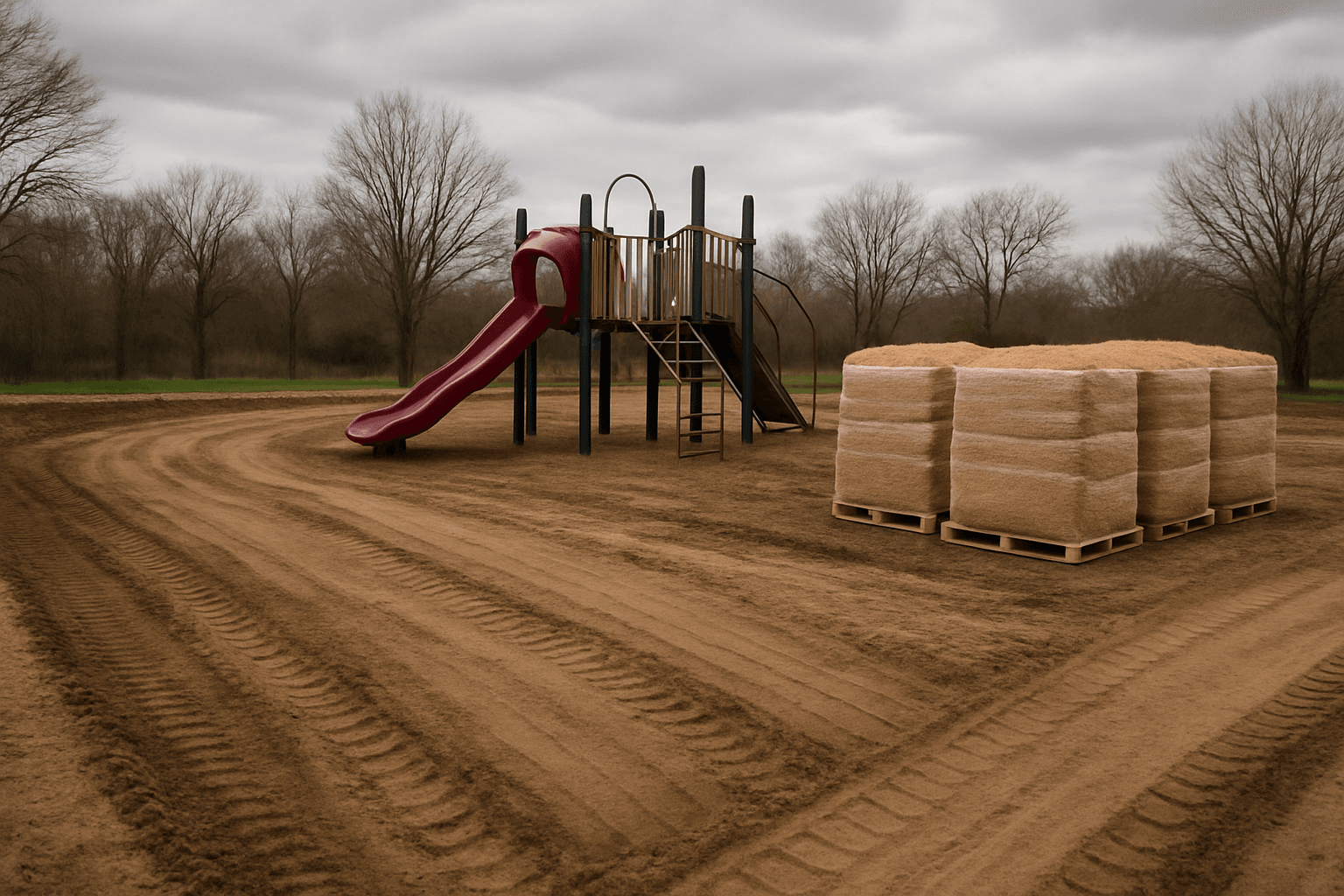
You can install the best engineered wood fiber on the market, get the depth right across every square foot of the fall zone, and still end up with a call back in six weeks because the mulch is washing into a corner and compacting down to two inches. The problem wasn't the mulch. It was the grade.
Site grading is one of those things that playground builders often skip reviewing before install because it feels like it belongs to the earthwork contractor or the GC. That's a mistake. Mulch behavior is heavily influenced by how the ground sits under it, and if you install on a bad grade, you own the results.
What Good Grade Looks Like for Playground Surfacing
The goal for a playground surfacing subbase is a gentle positive drainage slope away from the play structures, typically between 1% and 2%. That's about one inch of drop per eight feet of run. Enough to move water out of the fall zone without being steep enough to migrate mulch on its own.
You also want the subbase to be reasonably uniform. Pockets and low spots in the subbase become collection points for water and compacted mulch. If water has nowhere to go, it sits, softens the sub-base, and your mulch settles unevenly.
Check this before your crew starts laying material. It takes ten minutes with a level and a tape measure, and it can save you a return trip.
The Most Common Grading Problems on Playground Sites
Reverse slope toward the structure. Someone graded the site to drain toward the center, toward the play structure footings. Water and mulch both move to the low point. You end up with too-deep material in the center fall zone and shallow coverage at the perimeter where kids are most likely to fall.
Flat with no drainage path. The site looks level, and that feels safe. But flat with no drainage outlet means that any water that gets in stays in. After a week of rain, you've got standing water under your mulch, which accelerates compaction and biological breakdown. You'll be adding top-off material within a season.
Grade break inside the fall zone. This is where one section of the site drains one direction and another section drains the other way. You end up with a ridge or valley running through the active play area, and mulch migrates to both edges. It's invisible from a walk-through but shows up clearly when you pull out a level.
Site graded tight to adjacent curb or border. If the finished grade of the subbase sits at the same elevation as the top of your containment border, you've got no room for mulch depth plus positive drainage. Either the mulch won't reach spec depth, or it's going to spill over the containment edge.
What to Do When You Find a Grading Problem
If you catch it before install, you're in good shape. Document what you found with photos, flag it in writing to the GC or owner, and get direction before you put a yard of mulch in the ground. Do not install over a known grading defect without written confirmation that the owner accepts the condition. If the mulch fails to perform because of the grade and you didn't note it, you'll be back on your dime.
If the grade is only slightly off (within about half a percent), you can sometimes compensate by adjusting your mulch depth at the low points to maintain spec coverage. That's a judgment call and needs to be documented.
If the grade is significantly off, it needs to be corrected before you start. You're not in the earthwork business, but you should be direct about what needs to happen and who needs to do it.
How to Protect Yourself on Every Job
Add a site pre-inspection to your standard process. Before material gets ordered or scheduled, walk the site with a level. Check grade direction, identify low spots, verify the drainage path exits the fall zone cleanly.
If the subbase isn't your scope, that's fine. Document what you see, note it in your pre-installation checklist, and share it with whoever is responsible. That creates a record that you flagged the condition and isn't on you if the grade doesn't get fixed before your crew shows up.
A playground surfacing job that performs well for three years is a reference. One that calls back in the first season is a cost. The extra ten minutes on site before install is worth it.