Most Builders Know ASTM F1292 Exists. Fewer Know What It Tests.
That gap matters. When a fall injury happens on a playground you installed, the first question from an attorney is whether the surfacing met critical fall height requirements on the day of the incident. Not the day you installed it. The day of the injury. That's a different question, and answering it correctly requires understanding how the standard actually works.
Here's what it actually tests.
What ASTM F1292 Actually Measures
ASTM F1292 measures impact attenuation, the ability of a surface to slow down a falling body and absorb the energy of that impact. It doesn't test the material in isolation. It tests the surface system as it's actually installed.
The standard uses two metrics:
g-max: The peak deceleration experienced during impact, expressed as a multiple of gravitational force (g). The threshold is 200g. Surface systems have to stay below that ceiling.
HIC (Head Injury Criterion): A time-weighted measure of impact severity that more closely reflects actual head injury risk than peak g-force alone. ASTM F1292 sets the HIC limit at 1,000.
Both metrics have to pass. You can hit the g-max number and still fail the test if HIC is out of range. A surface that passes one but not the other isn't compliant.
Critical fall height is the output. A surface that passes both g-max and HIC tests at a given drop height is certified to that height. If your equipment has a fall height of 8 feet, your surfacing needs a critical fall height of at least 8 feet.
How Depth Tables Come From Test Data
The depth tables on certified spec sheets, 6 inches of EWF for up to 7 feet, 9 inches for up to 10 feet, 12 inches for up to 11 feet, those numbers come from actual drop tests. Not from convention, not from guesswork.
Testing labs use an instrumented headform dropped from measured heights onto installed surfacing material. They run repeated tests at increasing drop heights until the surface fails one of the two thresholds. The depth at which each material passes both metrics at each height becomes the published spec.
This is why you can't substitute non-certified materials and expect the same results. Pea gravel, wood chips, and common landscaping mulch have never passed ASTM F1292 testing at depths practical for playground use. The CPSC explicitly excludes them. The reason isn't that they're unnatural or that someone decided to be strict. It's that they don't absorb impact energy the way certified EWF and rubber mulch do.
Compaction Is the Variable Builders Miss
Here's where a lot of installations start drifting out of compliance without anyone noticing.
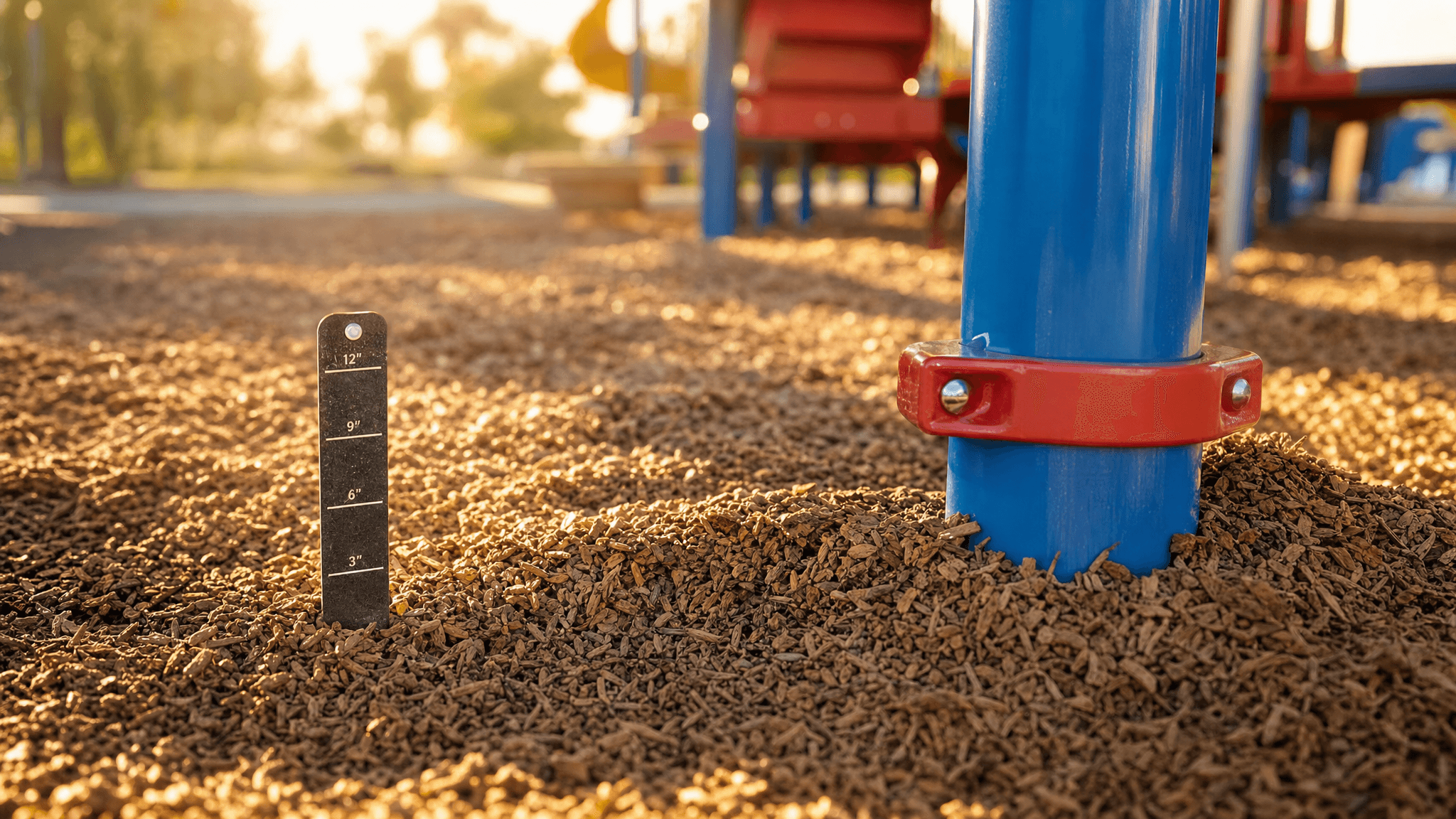
The critical fall height ratings on EWF spec sheets assume freshly installed, uncompacted material. Engineered wood fiber compacts over time. A surface that measured 12 inches on installation day will typically settle to 9 or 10 inches within the first season, then keep losing effective depth from foot traffic, rain compaction, and freeze-thaw cycling.
The ASTM F1292 critical height rating for your EWF isn't a permanent number. It degrades as the material compacts and migrates.
This is why ongoing depth verification matters more than the initial installation. An 11-foot critical fall height rating on fresh EWF doesn't mean you're covered three years post-install if no one has checked depth since. The surface has to meet requirements on the day it needs to perform.
A reasonable field rule: check depth at the five high-wear zones at least twice a year. Swing bays, slide exits, climbing structure perimeters, and the main entry path. If any zone drops below the required depth for your equipment's fall height, it needs to be topped off before the playground reopens.
The 80% threshold is common in maintenance guidelines: when depth drops to 80% of required minimum, schedule a top-off. At 60%, close the fall zone until the surface is brought back into compliance.
How Certified EWF Gets Tested and What to Check
IPEMA (International Play Equipment Manufacturers Association) runs a product certification program for loose-fill surfacing materials. Third-party labs test the material to ASTM F1292, and IPEMA certifies products that pass.
When you're sourcing EWF, look for:
- IPEMA certification label on the product data sheet
- The specific critical fall heights the product is certified to (this varies by manufacturer and material density)
- The installation depth those heights are based on (9-inch depth rating vs. 12-inch depth rating are different specs)
- A certificate of conformance number you can reference in your closeout documentation
That cert number matters. If there's ever a claim, you need to demonstrate that the product installed was actually tested and certified, not just described as certified by a salesperson.
GetMulch provides IPEMA-certified EWF with a certificate of conformance on every delivery. That documentation goes in the project file.
What a Failed Impact Attenuation Test Means
Owners occasionally call for third-party testing after installation, particularly on larger public projects. If a test comes back with g-max above 200 or HIC above 1,000, the situation changes quickly.
The owner now has documented evidence that the surface is non-compliant. Depending on contract language, that can put remediation costs on the installer. More critically, if a fall injury occurs after a failed test, there's a clear record that the owner knew the surface wasn't compliant and didn't fix it. That changes the liability exposure for everyone who touched the project.
From a contractor's standpoint, your best protection is depth verification at closeout. Measure at the required zones. Document the readings. Get owner sign-off. If the material is certified and depth is confirmed at closeout, you've done your part.
Pre-Closeout Field Checklist
Before you walk off a playground installation, confirm:
- Material cert: IPEMA certification number matches the product delivered
- Depth readings: Measurements at each critical zone (swings, slide exits, climbing perimeters)
- Lowest reading is your compliance number: If the swing bay reads 8 inches on one side and 11 on the other, 8 inches is what counts
- Equipment fall height verified: Fall height is measured from the highest accessible platform, not the peak of the structure
- Containment intact: Borders and edging are secure; mulch can't migrate out of the fall zone
- Owner handoff document: Includes the depth readings, the IPEMA cert number, the maintenance threshold (top off at 80% of minimum depth), and your sign-off date
That checklist takes 20 minutes on site. The documentation it produces stays relevant for years.
Get the Material Right From the Start
All of this starts with sourcing IPEMA-certified EWF from a supplier who backs it up with real documentation. GetMulch delivers certified engineered wood fiber with a certificate of conformance and full compliance paperwork on every order, whether you're doing one site or a dozen.
Ready to spec your next project? Get a quote at getmulch.com/get-a-quote.