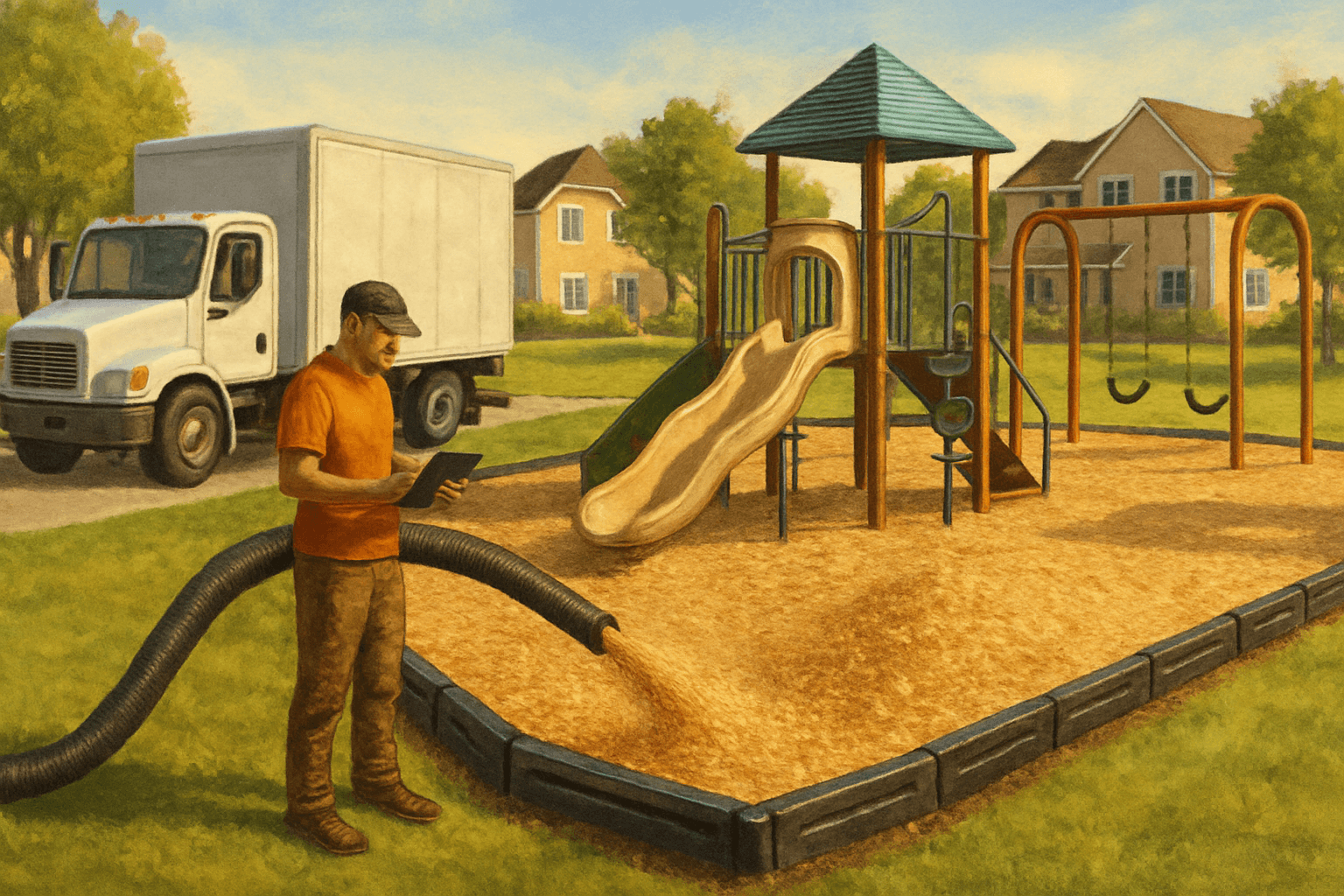
ASTM F2075 is the standard that defines what engineered wood fiber (EWF) must be before it goes under a playground. If you're bidding a project with EWF surfacing or specifying it for a school, park, or daycare, this is the document your material supplier has to pass. Here's what it requires, what it rules out, and what happens when a load of EWF shows up and doesn't meet spec.
What Is ASTM F2075?
ASTM F2075 (current edition: F2075-23) is the Standard Specification for Engineered Wood Fiber for Use as a Playground Safety Surface Material under Playground Equipment. It defines the physical properties EWF must meet: particle size distribution, moisture content, contamination limits, and handling requirements.
It's a material specification, not a performance test. Think of it as the ingredient standard -- it tells you what the material is, not how it performs.
How F2075 Differs from F1292
Specifiers sometimes confuse F2075 with ASTM F1292. They're related but test different things.
ASTM F1292 measures impact attenuation -- how well a surfacing material absorbs the force of a fall. It tests the installed system (material plus depth plus compaction) and produces a Head Injury Criterion (HIC) and g-max value. Pass or fail depends on the equipment's critical fall height.
ASTM F2075 tests the EWF material itself before installation. It's about particle geometry, moisture, and contaminants, not fall performance.
A truckload of EWF can pass F1292 impact testing at 9 inches deep and still fail F2075-23 if the particle size distribution is off or moisture content is out of range. Both standards apply. F2075 tells you whether the product is EWF. F1292 tells you whether it performs.
Who Needs to Comply with ASTM F2075?
Any project specifying EWF surfacing under playground equipment should require F2075-23 compliance from the supplier. In practice, compliance is expected by:
- CPSC guidelines (the Handbook for Public Playground Safety references EWF material standards)
- State playground inspection programs that reference ASTM standards by name
- Architects and landscape architects specifying per ASTM for liability protection
- School districts, municipalities, and park departments writing bid specs
The contractor's job is to source EWF that meets the standard and document it. If the spec says "ASTM F2075 compliant EWF" and you install something that fails, the liability lands on you.
Key F2075-23 Test Requirements
| Requirement | Specification | |---|---| | Maximum particle length | 2 inches (50 mm) | | Maximum particle width | 1 inch (25 mm) | | Maximum particle thickness | 0.5 inch (12.7 mm) | | Moisture content | 10% to 20% by weight | | Passing 1/4 inch screen (fines limit) | No more than 30% of material | | Foreign material (stones, metal, glass) | Zero tolerance | | Wood species | Untreated, non-toxic species only |
All values from ASTM F2075-23. Material certificates should reference this edition.
Particle Size: Why It Matters on the Ground
The particle size limits in F2075-23 aren't arbitrary. Material that's too fine compacts into a hard layer that doesn't attenuate falls the way loose fiber does. Material that's too coarse produces long, flat shards that create trip hazards and splintering risk.
The 30% passing 1/4-inch screen limit is the one contractors see violated most in the field. Suppliers running EWF through aging grinders sometimes produce too much fine material. The result looks like EWF, passes a visual inspection, and fails a lab screen test. You won't know without the certificate.
Moisture Content: The Installation Window
F2075-23 sets moisture content between 10% and 20% by weight. Below 10%, the fibers become brittle and can become airborne in dry conditions. Above 20%, the load is heavy, compaction becomes a problem, and mold risk climbs.
EWF delivered after wet weather can arrive at 25% to 30% moisture. That material isn't automatically condemned -- it may dry into compliance -- but installing it wet causes problems. Request the supplier's moisture certificate for the specific load, not just a blanket product certification dated months ago.
What Happens When EWF Fails F2075?
If a material sample fails F2075-23, the supplier can't represent the product as F2075-compliant EWF. Practical consequences:
- The material is unacceptable under any specification requiring ASTM F2075-23 compliance.
- If already installed, the contractor bears removal and replacement costs.
- Any F1292 impact attenuation test result on that material won't satisfy a spec requiring compliant EWF.
- Defending a personal injury claim becomes significantly harder when the material documentation is absent or failed.
Require a test certificate before installation, not after. Get a Certificate of Conformance or a third-party lab report referencing F2075-23. Keep it in the project file.
FAQ: ASTM F2075 for EWF Projects
What is the difference between ASTM F2075 and ASTM F1292?
F2075-23 is a material specification for engineered wood fiber -- it defines what EWF must be (particle size, moisture, contaminants). F1292 is a performance test for installed surfacing -- it measures fall attenuation at a specific depth. Both can apply to the same project, and they measure different things. A material can pass one and fail the other.
Does my EWF supplier need to provide an F2075 test report?
Yes, if your spec calls for ASTM F2075-23 compliance, the supplier should provide a Certificate of Conformance or a third-party lab report. A generic product data sheet is not sufficient documentation on a bid that specifies ASTM F2075-23 compliance.
Can EWF fail F2075 but still pass F1292 impact testing?
Yes. F1292 tests the installed system and doesn't evaluate source material chemistry or particle geometry. A non-compliant EWF product might still absorb impact at a given depth, but it won't satisfy a specification requiring F2075-23-compliant material. Both standards exist because they catch different failure modes.
How often should installed EWF be tested for ongoing compliance?
ASTM F2075-23 doesn't prescribe a maintenance testing schedule for installed surfaces. ASTM F3012 covers inspection of installed playground surfacing. As a baseline, any new delivery should be covered by a current certificate. For established installations, annual inspection using ASTM F3012 protocols is standard practice.