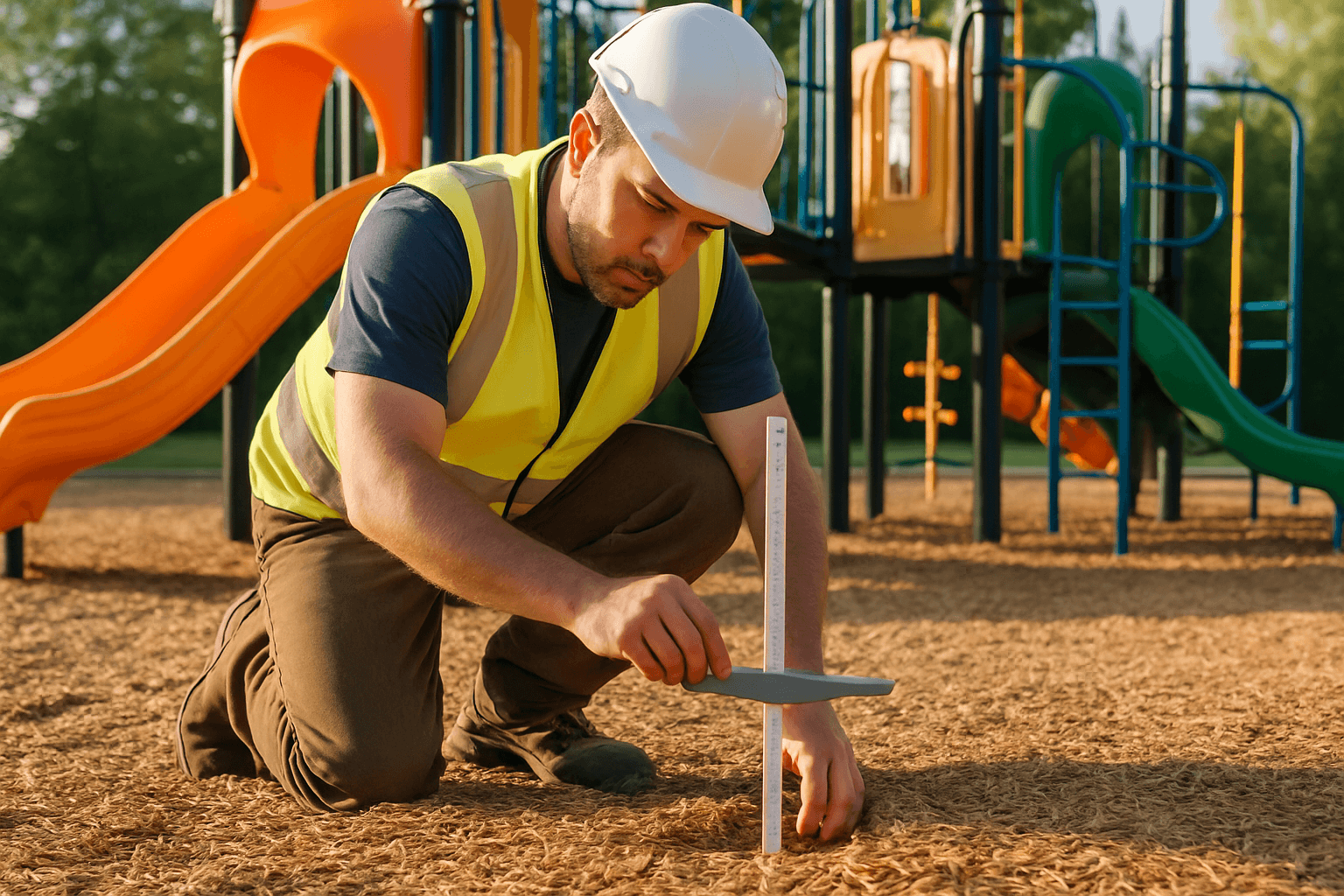
You quoted 9 inches of EWF for a playground build. The spec was approved, the material delivered, the install done. Six months later, the owner calls. An inspector flagged the depth at 6.5 inches, the climber tops out at 8 feet, and now you've got a compliance problem.
That gap between installed depth and required depth happens more than it should. The fix isn't complicated - you just need to know which depth to target for the fall heights on your site, and then install enough extra material to account for what's coming.
Here's how to work through the depth selection on any playground job.
Fall Height Is Not Equipment Height
This is where most depth miscalculations start.
Fall height is the distance from the highest accessible point on the equipment to the playing surface below. It's not the total height of the structure - it's the highest point a child can reach during normal play.
On a composite structure with a 6-foot deck, kids will stand on that deck. Fall height: 6 feet. A climber that tops out at 8 feet? Fall height: 8 feet.
Measure it yourself on every install. Don't rely on the architect's spec or what the sales rep told the client.
ASTM F1292 Minimums by Material
Once you've got your fall heights, ASTM F1292 gives you the minimum depth requirements. The numbers look like this:
Engineered Wood Fiber:
- 4 ft fall height - 6 inches minimum
- 6 ft fall height - 9 inches minimum
- 8 ft fall height - 12 inches minimum
Shredded Rubber Mulch:
- 4 ft fall height - 6 inches minimum
- 6 ft fall height - 6 inches minimum
- 8 ft fall height - 6 inches minimum
- 10 ft fall height - 9 inches minimum
- 12 ft fall height - 9 inches minimum
Rubber mulch has a real advantage at higher fall heights. EWF needs 12 inches for an 8-foot fall height; rubber gets there with 6 inches. For equipment over 8 feet, rubber mulch is often the smarter call from a depth standpoint alone.
But here's the thing: these are minimums for material in good condition, properly installed. They're not what you should target on install day.
Install Deep. Compaction Will Take Some Back.
EWF compacts. It breaks down over time, settles under foot traffic, and migrates out of the fall zone. A 12-inch EWF install on a busy school playground can drop to 9 inches within a full school year.
That 3-inch drop moves you from compliant to non-compliant for an 8-foot fall height. It happens without anyone doing anything wrong.
The standard approach is to install 15-20% deeper than the ASTM minimum to build in a compaction buffer:
- Minimum 6 inches? Install 7-8 inches.
- Minimum 9 inches? Install 11 inches.
- Minimum 12 inches? Install 14-15 inches.
Rubber mulch doesn't compact the same way, but it migrates. Swing zones and slide exits will thin out faster than open areas. Budget 10-15% overage on rubber jobs and make sure your containment borders are solid before the pour.
EWF or Rubber: Which to Use at Each Fall Height?
The depth requirements alone don't make the decision for you. Here's a practical breakdown by fall height range:
Under 6 feet: Either material works at comparable depth (6-9 inches). EWF is usually cheaper. Rubber costs more upfront but holds depth better over time. Let budget and site use intensity guide the call.
6-8 feet: This is where rubber mulch starts to look better. EWF needs 12 inches at 8 feet; rubber only needs 6 inches. On a site with taller equipment, rubber cuts your material volume significantly and reduces long-term maintenance.
Over 8 feet: EWF isn't certified to meet ASTM F1292 at standard depths for fall heights above 8 feet. For equipment hitting 10-12 feet, you're in rubber mulch or poured-in-place rubber territory. Don't try to make EWF work here.
Verify Before You Leave the Site
Depth isn't something you can estimate by eye. Take measurements before the crew wraps up.
Check the three highest-risk zones on every job:
- Directly below and around climbing structures
- Swing arc zones (6 feet in front of and behind the swing pivot)
- Slide exits (4-6 feet from the base of the slide)
Use a depth gauge or a rigid ruler pushed straight to the base. Take 5 or more readings per zone and average them. If any zone reads below the ASTM minimum for your fall height, you're adding material before anyone leaves.
Write down what you measured. A quick log with the date, location, zone, and depth reading is your documentation layer if you ever need to prove the install was in spec at completion. Keep it with the delivery receipts.
Top-Off Schedules Worth Sharing with Owners
Don't let the owner think this is a set-it-and-forget-it install. Be straight with them about what maintenance looks like:
- EWF at public playgrounds: Annual inspection at minimum. Quarterly checks at high-use sites.
- EWF at school playgrounds: Before school starts in fall, and again in spring. Add a mid-year check if the equipment gets heavy use.
- Rubber mulch: Annual inspection. Focus on swing zones and slide exits where migration runs highest.
Top-off means bringing the depth back to ASTM minimums - not back to the original overage depth. The goal is compliance, not replicating the day-one install volume.
Get the Volume Right From the Start
Calculating coverage is straightforward once you know your target depth. Multiply your fall zone square footage by your depth in inches, then divide by 324 to get cubic yards. For a 2,500 sq ft fall zone at 12 inches depth, you're looking at roughly 93 cubic yards.
GetMulch delivers IPEMA-certified EWF and rubber mulch to job sites across the country. Get a quote at getmulch.com/get-a-quote - tell us the fall zone square footage and your target depth, and we'll confirm the volume and get delivery coordinated to your schedule.