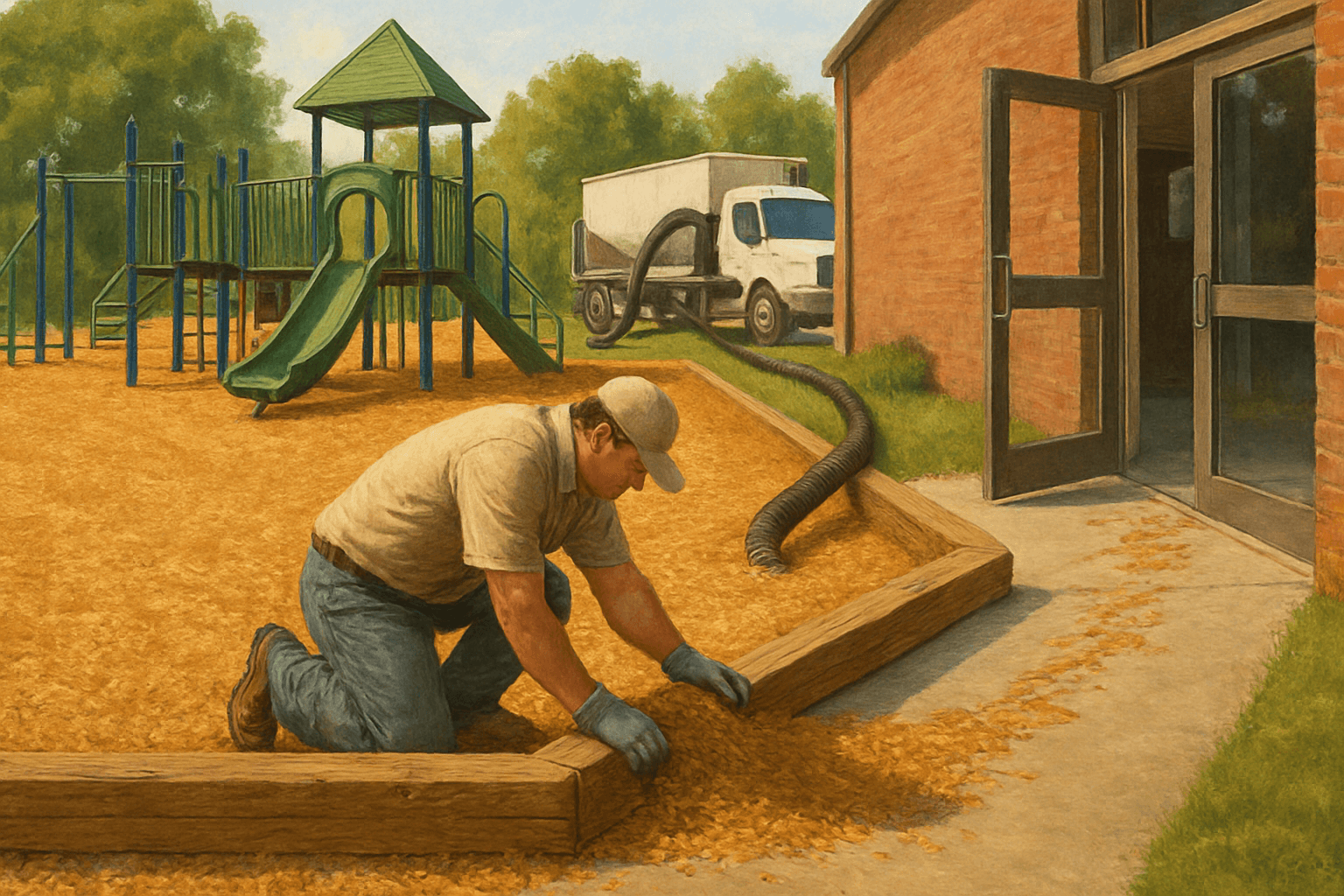
You wrapped up a playground installation last week. The mulch depth's right, the borders are solid, and the drainage is good. Then Thursday afternoon your phone rings. The facilities manager at the school is upset because her custodial staff is sweeping mulch out of the front hallway every morning.
It's a complaint you've heard before. And if you haven't, you will.
Mulch tracking is one of the most common friction points between playground contractors and their clients after installation. The mulch isn't failing. The install wasn't bad. But that doesn't make the complaint go away, and it won't make your client any less annoyed when they're staring at a pile of engineered wood fiber on their tile floor.
Here's how to handle it professionally, fix the actual problem, and make sure it doesn't blow up your next renewal.
Take the Call Seriously
Your first instinct might be to explain why tracking is normal. Don't lead with that.
The facilities manager doesn't want an education on mulch behavior. She wants to know that you heard her and that you're going to do something about it. Start there.
Pick up the phone, don't text. Acknowledge the issue specifically: "You're getting mulch in the hallways near the east entrance, right?" Tell her you'll come take a look in person. That single move, showing up, separates you from every contractor who sent a form email response.
When you get there, bring a notepad. Walk the complaint path with her, from the play area to the entrance. Look at where the mulch is concentrated. Is it happening at one door? After recess? After rain? The answers tell you what kind of fix is actually needed.
Why Tracking Happens (and How to Diagnose It)
Mulch tracks into buildings for a handful of reasons, and the solution depends on which one you're dealing with.
High foot traffic patterns. If kids are running from the play area directly into a building entrance with no transition surface between the rubber or wood fiber and the door, mulch is going to follow them inside. That's physics, not a defect.
Perimeter containment gaps. If the border edging has shifted, settled, or wasn't installed tight enough, mulch migrates outward. Once it's on the sidewalk, it's on shoes, then it's inside.
Mulch depth too thick near exits. Deep mulch close to a high-traffic exit point means kids are kicking through it constantly. You end up with a displacement problem at exactly the worst spot.
Rain and wet conditions. Wet wood fiber mulch sticks to everything. A wet playground after a rainstorm is going to track more than a dry one. Engineered wood fiber is especially prone to this.
Once you know what's driving it at your specific site, you can price a real solution instead of guessing.
The Fix: Short-Term and Long-Term
Some fixes take an afternoon. Others need to go in the next proposal.
Short-term moves you can do now:
- Pull mulch back from the perimeter near exit points by 6 to 8 inches, creating a buffer zone where kids naturally step down before they hit pavement
- Check and re-set any border edging that's moved; a solid border does more to stop tracking than any other single factor
- Add a rubber entry mat or transition grate at the playground-to-pavement edge to catch loose mulch before shoes carry it onto the sidewalk
Longer-term solutions to bring back in writing:
- A poured-in-place rubber transition zone from the play surface to the pathway, which nearly eliminates tracking from rubber mulch systems
- A dedicated deceleration area at the exit, a few feet of concrete or pavers between the mulch edge and the building entrance
- Engineered wood fiber containment upgrades, including deeper curb borders in high-traffic zones
Real talk: most of the long-term fixes are change orders. That's fine. Document what you found, what the client wants, and what it'll cost. Put it in writing. A complaint handled well often becomes a scope expansion.
Set Expectations on the Front End Next Time
The best time to address mulch tracking is before the install is done.
When you're doing your walkthrough with a new client, point out the exit paths. Ask where kids typically go after they're done on the playground. If there's a direct path from the play surface to a building entrance, flag it.
Tell them upfront: "Anywhere you've got high foot traffic near the mulch perimeter, you'll want a transition surface. Otherwise you're going to see some tracking. We can build that into the scope now, or we can add it later if it becomes a problem."
Most clients appreciate being told the truth on the front end. It builds trust, and it removes the surprise when they call three weeks after install. Put it in your standard proposal language. One paragraph about tracking behavior and what prevents it. It's not a legal disclaimer, it's just good communication.
Keeping the Client Relationship Intact
A complaint handled badly costs you a renewal. A complaint handled well builds loyalty.
Don't be defensive. Don't send a quote before you've visited the site. Don't dismiss the problem because the install was technically correct. Go see it, solve it, and document what you did.
Follow up two weeks after you've made the fix. A quick call asking "did that take care of it?" takes two minutes and signals that you're a contractor who actually finishes the job.
Clients who trust you with complaints are clients who call you back for the next project. And in this business, repeat work from parks and rec departments, school districts, and property managers is where the volume lives.
GetMulch delivers consistent, contractor-grade mulch that shows up when your crew does. Visit GetMulch.com to see how we can keep your next installation clean and on schedule.